
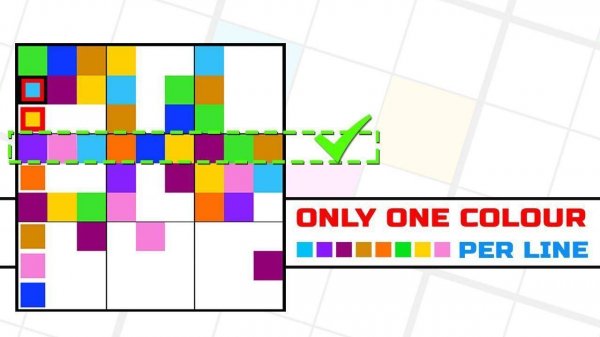
Chromatic Deduction Grid
About
Chromatic Deduction Grid takes the familiar concept of grid-based logic and gives it a fresh, visual twist. The use of colors instead of numbers makes the puzzles feel more accessible, yet the difficulty ramps up nicely as grids grow. The clean interface and lack of timers create a genuinely relaxing experience. I particularly appreciate the hint system, which teaches without hand-holding. It is a perfect game for unwinding while keeping the mind active.
Core Logic System
At its heart, Chromatic Deduction Grid presents players with an empty grid and a set of colored tiles. The primary rule is straightforward: each color must appear exactly once in every row and every column. This constraint creates a web of logical relationships that players must untangle. Unlike number-based puzzles, the use of colors adds a visual dimension that can make patterns easier to spot for some players, while still demanding careful reasoning. The challenge lies not in speed but in methodical deduction, as each placement affects multiple future possibilities.
Puzzle Generation and Difficulty
Each session begins with a fresh puzzle generated by the system. Early puzzles use smaller grids with fewer colors, allowing newcomers to grasp the fundamental logic. As players progress, the grid expands and the number of colors increases, introducing more complex interdependencies. The difficulty curve is smooth, ensuring that players are never overwhelmed but consistently engaged. Because puzzles are procedurally created, no two playthroughs are identical, providing near-infinite replay value for those who enjoy solving logical problems.
Visual Design and User Interface
The interface is intentionally minimal, with a clean layout that puts the puzzle front and center. Colors are distinct and easy to differentiate, even for those with mild color vision deficiencies. Tapping or clicking an empty cell brings up a palette of available colors, and the selected color is placed instantly. The grid updates in real time, and any row or column that becomes complete is visually marked. This feedback helps players track their progress without distraction. The design works equally well on touchscreens and desktop monitors.
Assistance and Learning Tools
For moments when the solution is not immediately clear, the game includes a hint system that suggests a correct placement. Using hints is optional, and the game encourages players to rely on their own reasoning first. There is no penalty for using hints, making them a helpful learning aid rather than a crutch. Over time, players internalize common logical patterns, such as elimination and cross-referencing, which improve their solving speed and accuracy. The game rewards careful thought rather than quick reactions.
Relaxed Pacing and Accessibility
Chromatic Deduction Grid is designed for relaxed play. There are no timers, no scores, and no pressure to perform. Players can pause at any moment and return later without losing progress. This makes it suitable for short breaks or longer sessions. The lack of competitive elements means the focus remains on the satisfaction of solving each puzzle. The game is appropriate for all ages, from children learning logical reasoning to adults seeking a calming mental exercise.








Comments
Sign in to comment
You must be logged in before posting a review or rating.
No account? Create one
No comments yet. Be the first to comment!